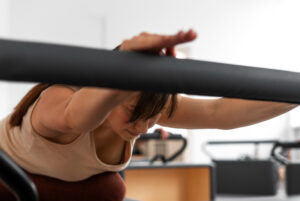
The Power of Precise Movement: Why Less is More in Pilates
Moving with control doesn't mean doing less, but doing better. In Pilates, the quality of movement is what generates true connection, strength, and balance.
In an era that rewards speed, the Pilates method proposes just the opposite: slow down to reconnect with the essence of movement and thus move with intention, precision, and awareness.. Instead of doing more repetitions or adding weight, practice invites us to go deeper. Because when each movement becomes conscious, each muscle works with intention, and the body begins to align with the mind.
That difference is key. At the beginning, when you start practicing, it's common for the pace to be slower since you're learning, but with time, practice will gain fluidity and you'll be able to do more exercises without sacrificing quality.
It's worth remembering that true Pilates doesn't aim for intensity or exhaustion, but for that much-needed harmony between body, mind, and spirit. It is a comprehensive practice that trains both attention and strength, breathing, and awareness. This deep connection is precisely what differentiates the original method from some accelerated versions circulating today.
When you move with precision, every gesture matters. Deep musculature is activated more effectively, breathing accompanies the movement, and the body works as an integrated system.. This approach reflects the heart of the original method.
As you adjust your alignment, movement, and intention, you start to notice how your body's sensation changes: less surface effort, more real connection. Each repetition becomes a training of attention, balance, and control.
and it is in this context that The Universal Reformer holds a special place within the system created by Joseph Pilates, A device that resists and assists at the same time thanks to springs, allowing for guided exploration of body control.
Springs help to better understand the direction of movement, the work of the center, and the coordination between stability and mobility. That's why it can be very useful as a learning tool... but it's not always the ideal start for everyone. In some cases, discomfort, pain, injuries, or the need for greater simplicity, ground work can be the most appropriate option to start building body awareness without adding external resistance.
The key is to understand that the entire system works in a complementary way: The mat, Reformer, and the rest of the equipment feed into each other. Each one contributes something different, and together they allow for a complete, balanced practice that can be adapted to any circumstance.
Because Pilates is not just physical exercise. It's a method to move better and understand your body from the inside. Practicing it with intention teaches you to listen to yourself, manage your energy, and find that sweet spot between stability and fluidity.